🏗️ Managers, Resources & Adapters
Every hardware driver in libhal is built from three distinct building blocks. Understanding which type to reach for, and why, is the first step in writing a correct driver.
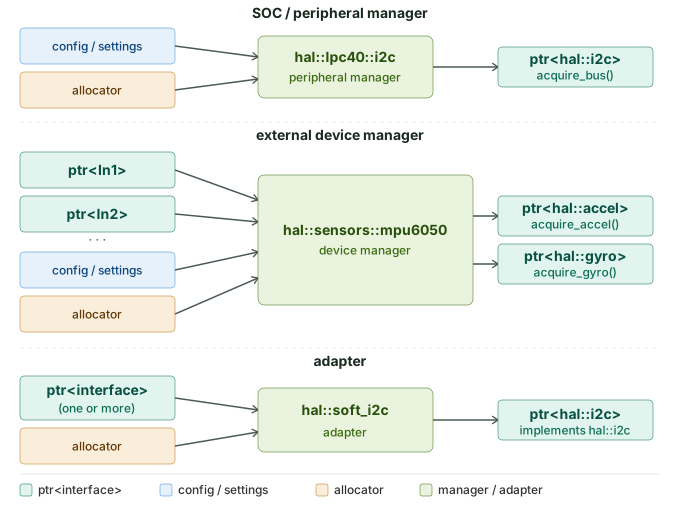
| Type | Owns hardware | Has vtable | Created by |
|---|---|---|---|
| Manager | ✅ | ❌ | create() factory |
| Resource | ❌ | ✅ | Manager acquisition |
| Adapter | ❌ | ✅ | create() factory |
Type Reference Legend
For clarity when reading documentation or code, please note the following mappings between hal aliases and their underlying types:
| Alias | Underlying Type |
|---|---|
hal::ptr<T> |
mem::strong_ptr<T> |
hal::allocator |
std::pmr::polymorphic_allocator<> |
hal::deferred_ptr<T> |
async::future<mem::strong_ptr<T>> |
Managers
A manager is the concrete class that owns and configures a single hardware component. It is the authoritative object for that hardware. Managers cover the full range of hardware libhal supports:
- SOC-integrated controllers: I2C bus, SPI bus, UART controller, GPIO port
- External devices connected over a protocol: an IMU over I2C, a smart servo over CAN, a display over SPI, a motor controller over RS-485
In both cases the role is identical. The manager initializes the hardware, holds its configuration, and hands out resource objects that let the rest of the application use it.
Properties
No vtable. Managers are concrete classes. They do not inherit from any hal
interface and have no virtual functions. The application holds them by
hal::ptr<ManagerType> and interacts with them directly.
Hidden implementation via enable_pimpl. All platform-specific state lives
in a nested impl struct defined only in the module implementation file. The
manager's public interface file forward-declares struct impl and derives from
hal::pimpl<T>. See Pimpl Pattern.
Single construction path. Managers are created only through a static
create() factory that returns either hal::ptr<ManagerType> or
hal::deferred_ptr<ManagerType> depending if the constructor/factory needs to
perform an async operation. Constructors are restricted from normal use via the
pimpl::private_key parameter. See
Construction Pattern.
SOC-integrated controller example
// hal/lpc40/i2c.cppm — module interface file
namespace hal::lpc40 {

export class i2c : public hal::pimpl<i2c> {
public:
  struct impl;  // defined in i2c.cpp only

  struct settings {
    hal::hertz clock_rate = 100_kHz;
  };

  [[nodiscard]] static hal::ptr<i2c> create(
    hal::allocator p_resource,
    hal::u8 p_bus,
    settings const& p_settings = {});

  [[nodiscard]] hal::ptr<hal::i2c> acquire_i2c();

  i2c(private_key,
      hal::allocator,
      hal::u8,
      settings const&);
};

} // namespace hal::lpc40
External device example
External device managers take hal interfaces as constructor dependencies rather than touching hardware registers directly. The manager for an MPU-6050 does not know or care whether the underlying I2C bus is hardware-accelerated, bit-banged, or involves talking to a server.
// hal/sensors/mpu6050.cppm
namespace hal::sensors {
export class mpu6050 : public hal::pimpl<mpu6050> {
public:
  struct impl;

  [[nodiscard]] static hal::deferred_ptr<mpu6050> create(
    async::context& p_context,
    hal::allocator p_resource,
    hal::ptr<hal::i2c> p_bus,
    hal::u8 p_address = 0x68);

  [[nodiscard]] hal::ptr<hal::accelerometer> acquire_accelerometer();
  [[nodiscard]] hal::ptr<hal::gyroscope>     acquire_gyroscope();
  [[nodiscard]] hal::ptr<hal::temperature>   acquire_temperature();

  mpu6050(private_key,
          hal::allocator,
          hal::ptr<hal::i2c>,
          hal::u8);
};
} // namespace hal::sensors
Resources
A resource is the object a manager hands out. It implements one of the hal interfaces and is the only way application code interacts with the hardware the manager owns.
[!NOTE] While resources provide the standardized, generic interface used by other drivers to ensure interoperability, application code may also interact with managers directly if needed. However, we strongly prefer using resource interfaces to keep components decoupled. Furthermore, while a manager could theoretically depend on another manager, this is highly discouraged; always prefer finding a general
halinterface to solve dependency issues rather than depending on the specific API of a manager object.
Caution
TODO(kammce): also, I need to explain that adapters can be hybrid and use pimpl and also inherit. This is due to the fact that a lot of adapters simply adapt a set of things down to one and the manager machinery isn't useful in that case.
Type erasure is the default
Resources are returned as hal::ptr<hal::interface>. The concrete resource type
is an implementation detail hidden in the manager's implementation file. The
application never names it.
// Application code — the concrete type is never visible
auto manager = hal::lpc40::i2c::create(alloc, hal::port<2>, {
  .clock_rate = 400_kHz
});

hal::ptr<hal::i2c> bus = manager->acquire_i2c(alloc);

// bus flows into anything that accepts hal::i2c
auto imu = co_await hal::sensors::mpu6050::create(ctx, alloc, bus);
Returning a type-erased interface pointer prevents ABI lock-in and lets LTO eliminate unused virtual dispatch paths when only one concrete type is present. Prefer this in every case where the application has no need for the concrete type.
Lifetime and co-ownership
Every resource co-owns its manager. Handing out a resource creates an aliasing reference to the manager's control block. The manager cannot be destroyed while any of its resources are live, regardless of whether the application still holds the original manager pointer.
Rare exceptions
Two patterns expose a concrete resource type. Both are ABI commitments and should be treated with the same gravity as adding any public type to the library.
Named concrete return. Used when the resource type has a public API richer than its base interface and callers need that API:
// The concrete type is intentionally part of the public API
[[nodiscard]] hal::ptr<lpc40::dma_channel> acquire_dma_channel(hal::u8 p_index);
Typed array return. Used when a manager hands out a fixed set of homogeneous resources and the array structure is meaningful to the caller:
// Rare: typed array — callers index by pin number
[[nodiscard]] std::array<hal::ptr<hal::output_pin>, 32> acquire_output_pins();
Warning
Both patterns bind the concrete type into the public ABI. Every future change to that type is a breaking change for downstream libraries. Exhaust type-erased alternatives before choosing either pattern.
Adapters
An adapter takes one or more existing hal interfaces and presents a different hal interface. It owns no hardware directly. Its only hardware access is through the interfaces it holds.
Adapters are useful when:
- A software implementation of an interface can be built from simpler primitives (bit-bang I2C from two output pins)
- A resource needs to be scoped or decorated before being handed further down the dependency chain (an SPI device that manages its own chip select)
- A protocol translation layer is needed (RS-485 half-duplex framing over UART)
// hal/soft_i2c.cppm — bit-bang I2C built on two GPIO pins
namespace hal {

export class soft_i2c : public hal::i2c {
public:
  struct settings {
    hal::hertz clock_rate = 100_kHz;
  };

  [[nodiscard]] static hal::ptr<soft_i2c> create(
    hal::allocator p_resource,
    hal::ptr<hal::output_pin> p_sda,
    hal::ptr<hal::output_pin> p_scl,
    settings const& p_settings = {});

  soft_i2c(private_key,
           hal::allocator,
           hal::ptr<hal::output_pin>,
           hal::ptr<hal::output_pin>,
           settings const&);

  hal::ptr<hal::output_pin> m_sda;
  hal::ptr<hal::output_pin> m_scl;
};

} // namespace hal
Adapters store all hal interface dependencies as hal::ptr<T> members, as with
any stored dependency. They are constructed via create() like managers.
Unlike managers they implement hal interfaces directly, so they carry a vtable
rather than a pimpl.
Naming Conventions
Managers Naming
SOC-integrated controllers live in a namespace named after the MCU family.
The class name matches the hardware block. The name of the driver should
closely match the name of the peripheral within the datasheet. For example,
hal::stm32f1::advanced_timer which contains timers, pwm output channel, pwm
input channels, quadrature encoding, and more.
hal::lpc40::i2c              — LPC40xx series I2C controller
hal::lpc40::spi              — LPC40xx series SPI controller
hal::stm32f1::usart          — STM32F1 series USART controller
hal::stm32f1::advanced_timer — STM32F1 series advanced timer peripheral
hal::rp2040::pwm             — RP2040 PWM block
External device managers live in a namespace named after the device category. The class name is the part number or established name of the device.
hal::sensors::mpu6050      — InvenSense MPU-6050 IMU
hal::displays::ssd1306     — Solomon SSD1306 OLED controller
hal::actuators::dynamixel  — Robotis Dynamixel smart servo
hal::io::pca9685           — NXP PCA9685 PWM expander
Adapters Naming
Adapters live in the hal namespace and are named after the interface they
produce, prefixed with the construction strategy or protocol where it adds
clarity.
hal::soft_i2c      — software bit-bang I2C
hal::soft_spi      — software bit-bang SPI
hal::spi_device    — SPI bus + chip select → spi_device interface
Resources Naming
Resources have no naming rule. Their concrete types are implementation details defined in module implementation files and are never part of the public API under normal circumstances.
Which type am I building?
| Question | Type |
|---|---|
| Does it own and configure a piece of hardware (chip, sensor, actuator)? | Manager |
| Is it produced by a manager and handed to the application as a hal interface? | Resource |
| Does it transform one or more existing hal interfaces into a different one? | Adapter |
When the answer spans two rows, the design needs a second look. A class that both owns hardware and implements a hal interface directly is trying to be both a manager and a resource. Split it: the manager owns the hardware, the resource implements the interface.